
Beyond the Standing Ovation
A film can win over Cannes or Venice in ten minutes flat. So why does it vanish before you can buy a ticket on a Tuesday?
For CRIT-ISH
The applause ends. What happens next?
When I first covered the Cannes Film Festival as a critic, I brought along a healthy amount of romantic idealism. I expected glamour, intellectual fireworks, and a pure celebration of cinematic art. The reality was a brutal, sweaty lesson in industry logistics: sprinting between press screenings with clanking badges, scribbling reviews on knees in overcrowded media lounges, and standing in endless queues under the baking Côte d'Azur sun while studio publicists managed the crowd like bouncers at an exclusive club.
Behind the red carpets and champagne receptions lies a high-pressure commercial trade fair. The gap between hype and reality is inherently dramatic—full of human vanity, economic absurdity, and quiet heartbreak. Like any other global market, the film industry is business as usual, and money is king.
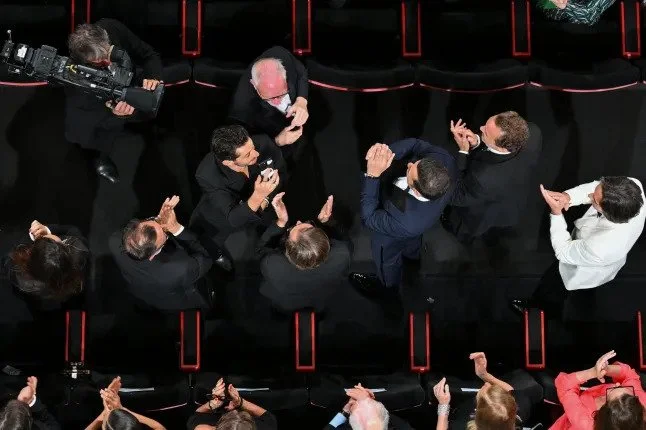
Filmmakers and cast receiving a standing ovation inside the auditorium at the Cannes Film Festival.
Image: Getty Images / Metro UK Feature Archive
Yet inside the grand auditoriums—whether the Palais des Festivals in Cannes or the Sala Grande in Venice—the magic still manages to stage a convincing show. A ten-minute standing ovation feels like a physical entity: a rolling wave of collective relief, tuxedoed exhaustion, and sincere appreciation washing over the cast and crew. By the time the house lights up, you feel as though the film has conquered the world. It exists in a golden bubble of five-star pull-quotes and trade-paper hyperbole.
When Jafar Panahi’s 3 Faces won Best Screenplay at Cannes in 2018, the critical consensus was glowing. But once I packed up my press pass and returned to Paris, trying to track down a regular theatrical screening felt like chasing a ghost.

Behnaz Jafari and director Jafar Panahi in 3 Faces (2018), winner of Best Screenplay at the Cannes Film Festival.[cite: 3]
Image: Courtesy of Jafar Panahi Film Production / The Guardian Review Archive
There is a strange, unacknowledged gulf between the frenzy of a festival premiere and the realities of getting a film in front of an ordinary audience. We treat festival acclaim as a guarantee of cultural success, as if a stamp of approval from the Croisette or the Lido automatically unlocks doors from London to New York. But a festival triumph is an event; commercial distribution is an administrative miracle. And the space between the two is where brilliant independent cinema goes to quietly expire.
From premiere to public release
To understand why a movie can make grown critics weep in a damp Venetian theater and still fail to secure a single screening in your neighborhood cinema, you have to look past the red carpet and into the chaotic, high-stakes bazaar of international sales.
Once the premiere dust settles, a film enters a shadowy global market managed by sales agents whose professional mandate is to slice up the world map like a disputed territory at a geopolitical summit. They negotiate country by country, cornering local distributors who must stare at a spreadsheet and calculate whether urban arthouse crowds will actually brave a Tuesday night for a subtitled Romanian tragedy or a three-hour Taiwanese character study about grief.

Industry delegates and sales representatives at the Marché du Film Village International in Cannes.
Image: Courtesy of Marché du Film / Variety Feature Archive
This is why a festival favorite can land a pristine, state-subsidized rollout in France—where an aggressive, federally protected cinema culture actively shields independent screens—while remaining completely orphaned across the Channel or the Atlantic. A buyer in London or New York isn’t just acquiring a work of art; they are adopting a financial high-wire act.
They have to gamble on minimum guarantees, translation costs, and the brutal reality of fighting for oxygen in multiplexes where eight out of ten screens belong to a CGI-heavy studio franchise.
A standing ovation gets a buyer into the screening room. It doesn't pay for the shipping hard drives, the subtitling, or the digital posters.
Acclaim isn’t a release strategy
The great joke of the contemporary festival circuit is that a film can be universally adored on a Sunday night and commercially radioactive by Monday morning.
Commercial expectations have narrowed into a terrifyingly small funnel. Marketing an independent film today routinely costs as much as—or double—the price of acquiring the movie itself. Because of that financial terror, distributors treat non-franchise cinema like a carton of unpasteurized milk with a three-day expiry date. If a project doesn't arrive pre-packaged with a viral TikTok stunt, an established intellectual property tag, or a bankable Hollywood lead, the people holding the purse strings panic.
Consider how differently two festival darlings can live or die under this regime. One arrives with a high-concept hook—say, a slick A24 genre-bender or a provocative celebrity narrative—that gives a distributor an excuse to unleash the PR machine and engineer it as the "must-see cultural event" of the month. It catches a wave, expands nationwide, and dominates every group chat from Brooklyn to Belleville.
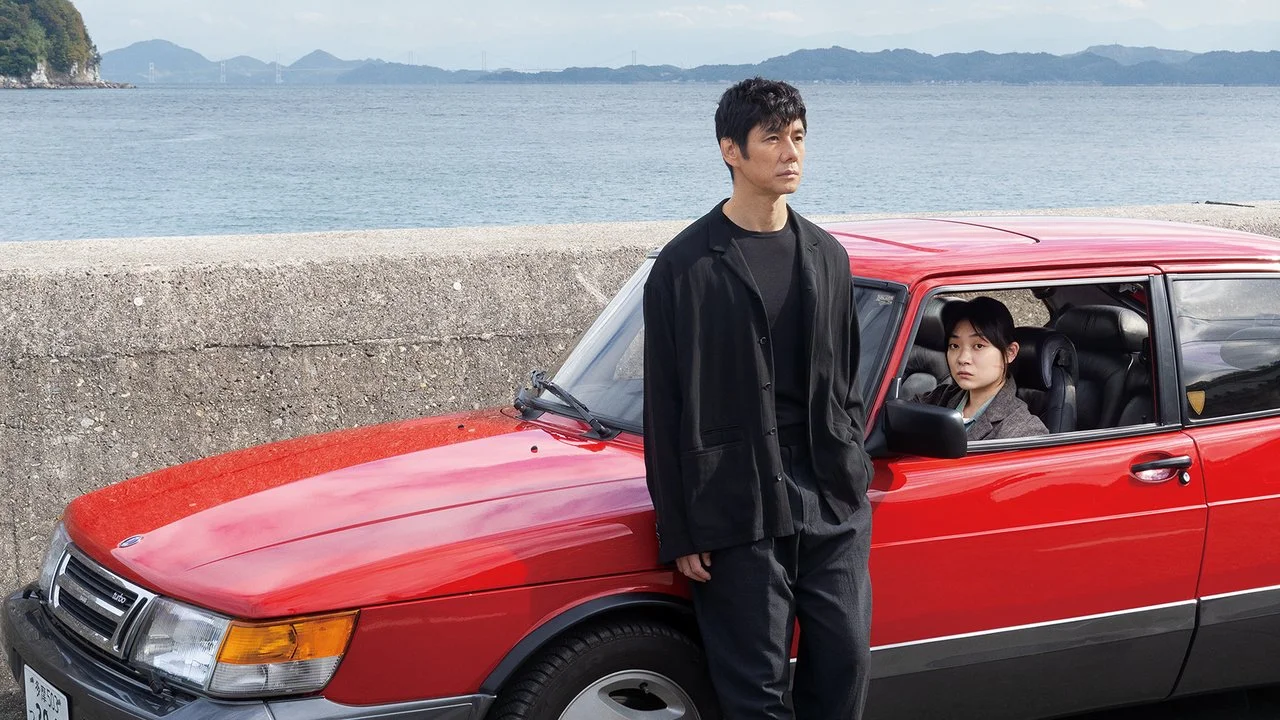
Hidetoshi Nishijima and Toko Miura in Ryusuke Hamaguchi’s Drive My Car (2021).
Image: Courtesy of Bitters End / MUBI Archive
Another film—say, Ryusuke Hamaguchi’s three-hour masterclass Drive My Car—relies entirely on its quiet integrity. Without a seven-figure marketing budget to manufacture urgency, it drifts through three festival slots, collects a respectful four-star review in an obscure film journal, and eventually lands on a streaming queue with the lonely dignity of an unread library book.
The critical establishment calls it a masterpiece. The market calls it a ghost.
Finding the audience beyond the festival
This is where the fragile, heroic ecosystem of independent exhibition steps in—though it can’t carry the structural weight alone. Independent picturehouses, repertory cinemas, curated streaming platforms like MUBI or Criterion, and opinionated critics are the only barrier keeping festival cinema from degenerating into a self-congratulatory parlor game for industry insiders.
When festival coverage fades and the red carpets are packed into crates, sustaining interest requires translating that initial burst of elite prestige into something personal and urgent for an ordinary viewer. It takes a programmer willing to stake a rainy Wednesday night slot on a delicate foreign feature, or a critic who can explain why a challenging, slow-burn film is worth the friction, rather than simply regurgitating the sales agent's glossy press kit.
Turning a moment of temporary acclaim into a lasting cultural connection demands more than a shiny palm leaf. It requires human advocates who are willing to bridge the gap between where the film was born and where the viewer is actually sitting.
Because a ten-minute standing ovation in Cannes or Venice is a wonderful noise. But it doesn't mean a thing if there’s nobody left in the dark when the lights finally go down.
Sources & References
Festival Archive: Festival de Cannes Official Archive — 3 Faces (2018)
Exhibition Policy: Centre National du Cinéma et de l'Image Animée (CNC)
Curated Platforms: The Criterion Channel & MUBI